

A stereogram is an image that hides two separate views, one for each eye, inside a single picture. Its best-known form, the autostereogram (single-image stereogram), is made of a pattern that repeats horizontally at small intervals. Where the hidden shape sits, that interval changes slightly. When your eyes focus behind or in front of the pattern, your brain reads those small differences as depth, and a 3D shape pops out of the flat surface. That's why stereograms are often called 3D hidden pictures or simply 3D pictures.
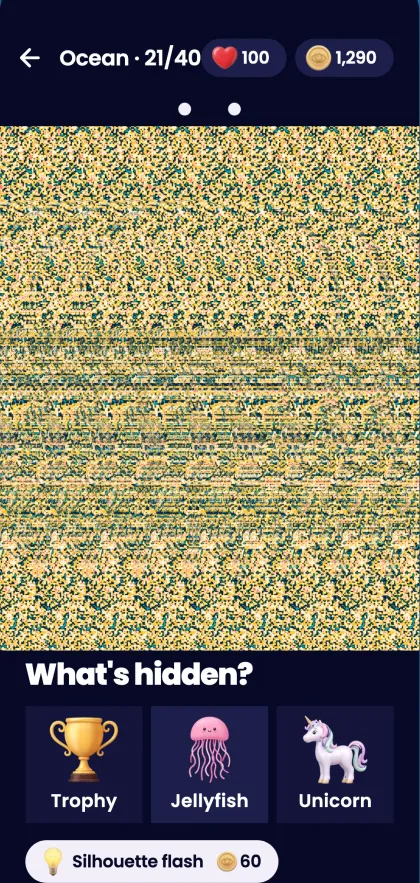
Ocean · 1/40
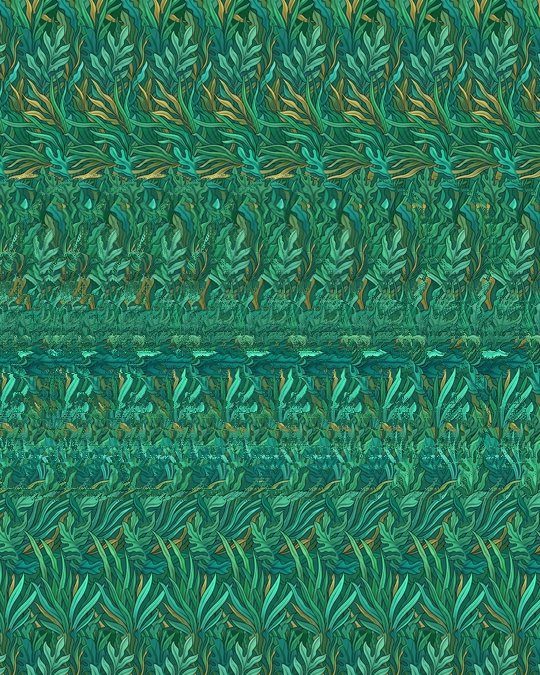


What's hidden?
Look through the screen until the two dots on top become three.
How does a stereogram work?
Two eyes, two views
Our eyes sit a few centimeters apart, so each one sees the world from a slightly different angle.
A repeating pattern
A stereogram's pattern repeats horizontally. When you look through the screen, your two eyes land on two neighboring repeats.
Small shifts
Where the hidden shape sits, the repeat gets slightly narrower. Your brain reads that difference as depth.
The shape rises
Your brain merges the two views, and a 3D shape pops out of the flat pattern.

Your brain measures the shift between the two views (binocular disparity) and turns it into depth; this ability is called stereopsis, or stereoscopic vision. A stereogram turns the process around: it hides the two views meant for your two eyes inside a single pattern.
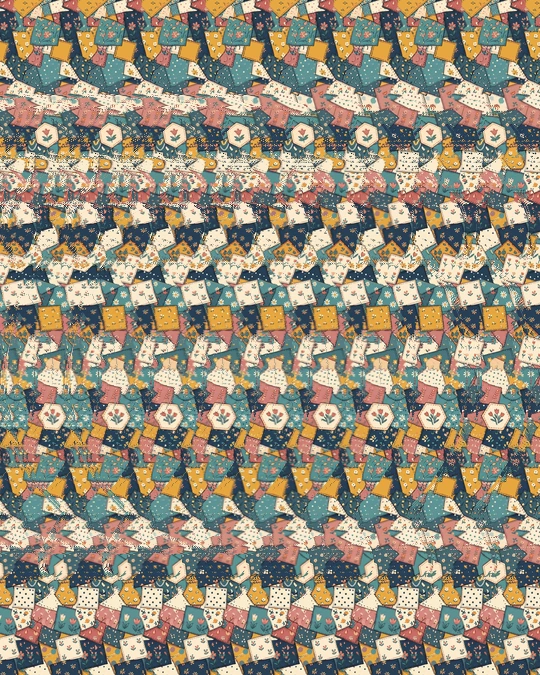
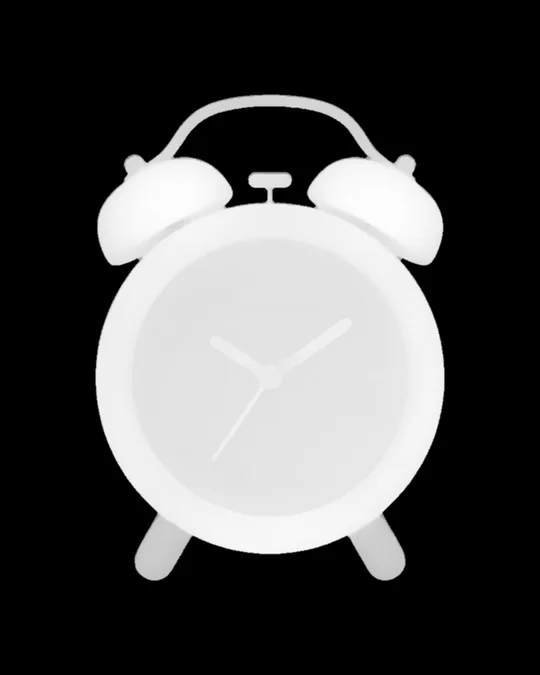
What is a depth map?
Every stereogram is drawn from a depth map: a grayscale image where white points are nearest and black points are farthest. The computer reads the map line by line and works out how far the pattern shifts at each point. You never see the map, but your eyes recover it from the pattern. If you want to make one yourself, you can draw it in your browser on the how to make a stereogram page.
Types of stereograms
- Stereo pairTwo pictures side by side, one for each eye. The first stereoscopes showed these.
- Random-dot (RDS)Two images of random dots; the shape shows only when both eyes look together.
- AutostereogramBoth views in one repeating pattern. Every level in the game is one.
- Text stereogramThe hidden shape is a word or a name. Sometimes the pattern is made of letters.
- Animated stereogram →Depth that changes frame by frame: the shape moves in depth.
- AnaglyphA 3D picture viewed through red-cyan glasses. A close relative, but it needs glasses.
A short history of stereograms
- 1838Charles Wheatstone explained how we perceive depth with two eyes and introduced the mirror stereoscope.
- 1844David Brewster described how repeating wallpaper patterns appear at a different depth when your gaze shifts. Today this is known as the wallpaper effect.
- 1849Brewster developed the lens stereoscope, and stereo photographs became common in homes.
- 1959Béla Julesz created the random-dot stereogram and showed that depth can be perceived from the difference between the two eyes alone, without any shape cues.
- 1979Christopher Tyler and Maureen Clarke fit both views into a single image: the single-image random-dot stereogram, or autostereogram.
- 1990sColorful computer-generated stereograms became a worldwide craze through books and posters.
- TodayStereograms are drawn right on the phone; our game creates every level instantly from a depth map.
Stereograms and stereoscopic vision
To see a stereogram, your two eyes need to work together. Some depth perception tests used by eye doctors rely on the same idea: random-dot stereograms. Most people can see stereograms with a little practice. Conditions that affect how the two eyes work together (such as strabismus or lazy eye) can make it harder. If you have any concerns about your vision, ask an eye doctor.
Is a stereogram an optical illusion?
In classic optical illusions (like lines of the same length looking different), your brain misreads the picture. With a stereogram, your brain gets it right: your two eyes really do receive different images, and your brain calculates real depth from them. The illusion is that your eyes focus on a point other than the screen. That's the same effect Brewster noticed in wallpaper.
How do you see a stereogram?
There are two ways: focus your eyes behind the screen (parallel viewing) or in front of it (cross-eye viewing). Step-by-step instructions for both, common mistakes and practice examples are in the how to see stereograms guide. For stereograms with answers, visit the stereogram pictures page.
Updated: